Time Tracking in the Public Sector: Obligations and the TVöD
Here’s what it’s all about:
- What Applies to Time Tracking in the Public Sector
- What the TVöD, TV-L, and civil service law govern
- What to Keep in Mind Regarding the Staff Council and the Service Agreement
- What a digital time tracking system must be able to do for government agencies
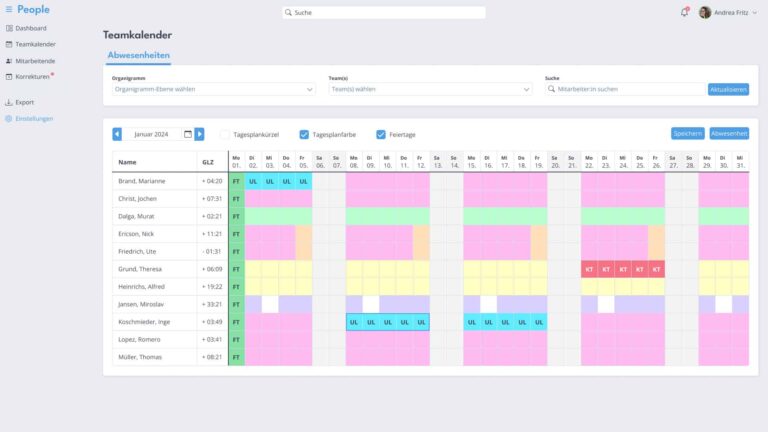
Working hours must also be systematically tracked in the public sector. However, different sets of regulations apply to employees covered by collective bargaining agreements and civil servants. In addition to the TVöD and TV-L, working hour regulations under civil service law and the staff council’s rights to co-determination must be taken into account. Digital time tracking helps government agencies transparently track flex time, time accounts, and mandated additional work, and technically implement the requirements set forth in service agreements.
⚠️ Time tracking in government agencies follows its own rules
Time tracking in the public sector differs from that in private-sector companies in several organizational and legal respects. This primarily concerns the coexistence of different employee groups, employee representation rights, and working time regulations for civil servants.
Even within a single local government, different sets of regulations may apply. Employees of the federal government and local governments who are covered by collective bargaining agreements are generally subject to the collective bargaining agreement for the public sector (TVöD). For employees of the states who are covered by collective bargaining agreements, the TV-L generally applies. Civil servants, on the other hand, are subject to the respective civil service laws and corresponding working time regulations.
👉 Time-tracking software for government agencies must therefore do more than simply record the start and end times of work. It should be able to track different work schedules, employee groups, departments, and time accounts separately.
🧐 What is the legal framework governing time tracking in the public sector?
The requirement to track working hours also applies to public-sector employers
In its judgment of May 14, 2019, in Case C-55/18, the European Court of Justice required an objective, reliable, and accessible system for measuring the number of hours worked each day. Based on this, the Federal Labor Court, in its decision of September 13, 2022, Case No. 1 ABR 22/21, concluded that employers in Germany are required to record the start and end times of daily working hours pursuant to Section 3(2)(1) of the Occupational Safety and Health Act.
Public employers are not generally exempt from this legal framework. The Occupational Safety and Health Act expressly defines public authorities and administrative agencies as “agencies” within the meaning of the Act. Furthermore, Section 2(2) of the Occupational Safety and Health Act expressly lists civil servants as “employees” alongside private-sector workers.
Nevertheless, a nuanced approach is required when it comes to civil servants. The BAG decision sets forth its guiding principle for employees. At the same time, additional or more specific working-time regulations under civil service law apply to civil servants.
👉 Government agencies should therefore review labor law and civil service law requirements separately and reflect them accordingly in the time-tracking system.
The TVöD does not apply to all public-sector employees
The TVöD is particularly relevant for employees covered by collective bargaining agreements with the federal government and municipal employers. Employees of the states are generally covered by the TV-L. For this reason alone, a government agency should not assume, when configuring the system, that there is a uniform working time regulation for the entire public sector.
Among other things, the TVöD governs regular working hours, special forms of work, working time accounts, as well as additional work and overtime. The specific weekly working hours and supplementary provisions may depend on the respective collective bargaining sector and other collective bargaining agreements.
👉 For digital time tracking, this means: Collective bargaining rules must be configurable as parameters rather than being dictated by rigid default values.
Civil service law has its own regulations governing working hours
For federal civil servants, for example, the Federal Working Hours Regulation (AZV) applies. The states have their own civil service laws and working hours regulations.
The federal AZV expressly contains provisions regarding flex time. Section 7 of the AZV provides, among other things, for flex time frames, possible core working hours or working periods, as well as rules for compensating for hours worked in excess of or falling short of the regular working hours.
👉 This makes it clear why digital time tracking is particularly well-suited to many administrative models. Time accounts and flexible work schedules can only be managed reliably if the actual hours worked are documented in a traceable manner.
🗣️ Staff Council vs. Works Council: Who Has a Say in Time Tracking?
In private-sector companies, employee participation is governed by the Works Constitution Act. In government agencies and traditional administrative units, this role is fulfilled by the staff council.
The Federal Personnel Representation Act (BPersVG) applies to federal agencies. For states and municipalities, the respective state personnel representation laws apply. The scope and procedures for employee participation may therefore vary from one state to another.
When does the staff council have the right to participate in decisions regarding time tracking?
For federal agencies, Section 80(1) of the Federal Personnel Co-determination Act (BPersVG) sets forth several grounds for co-determination directly related to working hours. These include:
🔵 Start and end times of the daily workday, as well as the distribution of hours across the days of the week
🔵 On-call duty, standby duty, additional work, and overtime
🔵 Introduction, Modification, and Repeal of Work Schedule Models
🔵 technical devices designed to monitor employees’ behavior or performance
This last point is particularly relevant in the context of digital time tracking. Section 80(1)(21) of the Federal Personnel Representation Act (BPersVG) covers technical equipment with the potential for surveillance.
Which specific provision applies to a local government or state agency must be determined by referring to the respective state law on employee representation. A blanket application of Section 87 of the Works Constitution Act (BetrVG) to public agencies would be legally incorrect.
👉 For more information on the structural parallels, see our blog post “Works Council and Time Tracking: Co-determination, Works Agreements, and Practical Implementation.” For government agencies, however, the law on employee representation remains the governing legal basis.
🤝 Service Agreement Instead of a Works Council Agreement
The terminology is also different. The agency and the staff council enter into a service agreement, not a works agreement.
For federal agencies, Section 63 of the Federal Personnel Representation Act (BPersVG) specifies the matters for which service agreements are permitted. These agreements are concluded jointly by the agency and the staff council and must be entered into in writing or electronically and publicized in an appropriate manner.
In the case of measures subject to co-determination, a federal agency may, in principle, act only after obtaining the required approval from the staff council or after the prescribed participation procedure has been carried out, in accordance with § 70 BPersVG.
👉 A service agreement on time tracking can, for example, govern methods of time tracking, correction procedures, access rights, reports, record retention, flex-time frameworks, and the management of time accounts.
🔍 What specific requirements must time tracking systems in government agencies address?
Flexible Hours, Core Working Hours, and Time Accounts
Flexible work schedules are widely used in government agencies. The key is to clearly distinguish between scheduled hours, actual hours worked, and accrued time off.
Suitable software should, among other things, be able to support different flex-time frameworks, individual part-time models, core or functional hours, and defined upper limits for time accounts. Rules derived from collective bargaining agreements, working time regulations, or service agreements should be clearly documented in the system logic.
Additional work is not the same for all employees
Special attention must be paid to distinguishing between employees covered by collective bargaining agreements and civil servants.
For federal civil servants, Section 88 of the Federal Civil Service Act (BBG) governs additional work. Additional work ordered or approved by the employer that exceeds five hours per month must generally be compensated by corresponding time off. For part-time employees, this limit is reduced proportionally. Compensation may be considered instead only under certain conditions.
Employees covered by collective bargaining agreements, on the other hand, are subject to the relevant definitions and compensation provisions set forth in those agreements.
👉 Software should therefore not lump together additional work, overtime, and flex-time credits indiscriminately in the same account.
Hours for the Public and Special Service Hours
Not every government agency operates exclusively during standard office hours. Citizen service centers may offer extended hours. Public order offices or other organizational units may require work schedules outside of regular administrative hours.
👉 The time tracking system must therefore be able to support both flexible administrative work schedules and fixed or rotating work models. At the same time, it should be possible to manage common rules centrally without losing sight of the specific needs of individual agencies.
Data Protection by Public Agencies
Work time data constitutes personal information and is subject to the GDPR. For public entities, additional federal or state data protection regulations may apply, depending on the governing body.
The jurisdiction of data protection authorities also differs from that of private-sector companies. Public authorities should therefore clarify, before implementing a time tracking system, which data protection authority has jurisdiction, the legal basis for processing data, and which roles will have access to personal time data.
👉 From a technical standpoint, the principle of data minimization should be taken into account. Not every manager needs access to all of an agency’s time data.
🚀 How Government Agencies Are Implementing Digital Time Tracking with the Staff Council
A structured onboarding process reduces the need for follow-up work later on and facilitates coordination between Human Resources, IT, department management, and the staff council.
Determine the legal basis and jurisdiction
First, it must be determined which Employee Representation Act, which collective bargaining agreement, and which civil service regulations governing working hours apply to the respective agency.
Notify the staff council in a timely manner
The staff council should not be involved only after the product and system configuration have already been finalized. Relevant functions, data types, and reporting options should be made transparent at an early stage.
Define Common Goals
Typical goals include a standardized calculation of flex time, transparent time accounts, fewer manual corrections, and clear documentation of mandated additional work.
Draft a service agreement
The service agreement should consolidate organizational and technical rules. These include, in particular, data entry procedures, access permissions, corrections, analyses, and regulations regarding time accounts.
Define Centralized and Decentralized Responsibilities
If there are multiple offices or branch offices, it should be clearly defined which parameters are maintained centrally and which tasks remain the responsibility of the respective organizational units.
Train Employees and Managers
Before the system goes live, employees as well as department and division heads should understand how postings, corrections, and approval processes work.
⚙️ Real-world example: Standardized time tracking in a local government office
The municipality of Tangerhütte demonstrates how different employee groups and work schedules can be managed centrally. There, an outdated system was replaced with a digital time tracking system for approximately 190 employees—spanning the municipal administration, daycare centers, public works departments, swimming pools, and other facilities.
In addition to standard administrative hours, the solution also accommodates shift schedules and on-call duties. The integration with payroll processing and the automated processing of electronic sick leave notifications further streamline HR processes.
You can learn more about the project and its implementation in our case study on the unified municipality of Tangerhütte.
🏫 Which time-tracking software is best suited for public administration?
For government agencies, it is not so much a single function that matters as the configurability of the overall system.
Implications for Government Agencies: Report employees under collective bargaining agreements and civil servants separately
Implications for Government Agencies: Managing Flexible Work Hours and Account Limits Based on Rules
Implications for Government Agencies: Restrict Access Based on Office, Role, and Responsibilities
Implications for government agencies: combining centralized rules with decentralized responsibilities
Implications for government agencies: Enable data entry via browser , terminal, or mobile device depending on the application
Implications for government agencies: Ensuring transparency without disclosing unnecessary personal data
Implications for government agencies: Integrate existing HR and payroll systems (e.g., with VOCUS, AKDB, Komm.ONE KM-Personal / dvv.Personal, etc.)
👉 For larger local governments and public agencies, for example, ZMI – Time can centrally consolidate working time models and various data-entry methods. Learn more. The ZMI time tracking system is already in use at public institutions and local governments and supports, among other things, flex-time and overtime accounts, as well as various organizational areas such as administration, public works, and daycare centers.
However, the individual configuration remains crucial. Software does not replace either a review of the relevant employee representation law or a required service agreement.
🤓 Conclusion: Public administration needs more than just standard time tracking
Time tracking in government agencies is not a single collective bargaining issue. Municipalities and other public agencies must consider collective bargaining law, civil service law, employee representation law, and data protection collectively.
👉 A suitable digital solution, therefore, does more than just track attendance times. It must be able to clearly distinguish between different employee groups, flex-time models, time accounts, departments, and access permissions. If the staff council is involved early on and the rules are set forth in a robust service agreement, the technical implementation can be based on a clear organizational foundation.
💡 FAQs on Time Tracking in the Public Sector
Does the requirement to track working hours also apply to civil servants?
Civil servants are expressly classified as employees under Section 2(2)(4) of the Working Hours Act (ArbSchG). In addition, special provisions under civil service law apply to their working hours. The Federal Labor Court’s (BAG) landmark decision on working time recording sets forth its guiding principle for employees. Government agencies should therefore take particular care to observe the applicable Working Time Regulation and other civil service regulations.
What is the difference between a staff council and a works council?
The works council is based on the Works Constitution Act and generally applies to private-sector companies. In public agencies, however, the Federal Personnel Representation Act or the state personnel representation laws apply. In those cases, the staff council represents the interests of the employees.
How can flex time and time accounts be documented in a legally compliant manner?
The system should clearly distinguish between actual working hours, scheduled hours, and time credits. In addition, the rules set forth in the collective bargaining agreement, the Working Hours Regulation, and the service agreement must be correctly configured.
Do different rules apply to additional work for civil servants than for employees covered by collective bargaining agreements?
Yes, civil servants are subject to the provisions of civil service law. For federal civil servants, for example, Section 88 of the Federal Civil Service Act (BBG) contains specific provisions regarding mandated or authorized additional work and compensation for it. Employees covered by collective bargaining agreements, on the other hand, are subject to the provisions of the applicable collective bargaining agreement.
Does every department need its own service agreement?
Not necessarily. Jurisdiction and scope depend on the organizational structure and the applicable employee representation law. Under the BPersVG, service agreements covering a larger area may take precedence over agreements covering a smaller area.
What data protection rules apply in addition to the GDPR?
Depending on the agency, the Federal Data Protection Act or state data protection regulations may apply in addition to the GDPR. The competent supervisory authority also depends on whether the agency in question is, for example, a federal, state, or local authority.

Jonathan Martin
Jonathan Martin is a managing partner at ZMI GmbH. For many years, he has been working in the fields of time tracking, HR software, access control, and the digitization of HR processes. In his articles, he provides practical insights into current developments, legal requirements, and digital solutions for businesses.