The discussion surrounding the mandatory recording of working hours has gained considerable momentum in recent years. This raises a central question for management and HR: does incorrect time tracking result in fines? And how can these consequences be avoided?
At the latest since the decisions of the European Court of Justice (ECJ) and the Federal Labor Court (BAG) as well as the forthcoming concretization by national regulations, it is clear that companies are obliged to systematically record working times.
What is often underestimated are the possible consequences of violations. Missing or incorrect time tracking is no longer a trivial offense, but can entail considerable legal and financial risks for companies.
Legal background: Why time tracking is mandatory
The obligation to record working time arises from the interpretation of the Working Hours Act (ArbZG) in the context of European requirements. Employers are obliged to introduce a system with which the daily working hours of employees can be recorded.
( Read all current rulings on the time recording obligationhere )
The aim of this regulation is to ensure compliance with maximum working hours, rest periods and break regulations and to make them verifiable.
For companies, this means that the responsibility lies entirely with the employer. And this applies regardless of whether the data is recorded by employees or not.
Time tracking fines: When do they apply?
Fines can be imposed in several cases and not only if no time tracking is carried out at all. Incomplete, incorrect or incomprehensible records can also be problematic for companies.
1. lack of time tracking
Companies that have not introduced a system for recording working time are in breach of the applicable requirements. In this case, fines may be imposed by the competent supervisory authorities.
2. incomplete or incorrect recording
Even if a system is in place, violations can occur if working hours are not fully documented, breaks are not recorded correctly or overtime remains untraceable. This risk is particularly high with manual or Excel-based solutions.
3. violations of working time regulations
If legal requirements are violated due to a lack of transparency, for example regarding maximum working hours or minimum rest periods, additional sanctions may be imposed.
4. missing evidence during audits
Companies must be able to present their working time documentation during inspections by the authorities. If this is not possible or the records are incomplete, this can also result in fines.
Amount of the fines: What penalties can companies expect?
Time tracking fines – the specific amount depends on the individual case. However, the Working Hours Act provides a clear framework: Fines of up to 30,000 euros per violation are possible. The consequences can be even more serious in the case of deliberate or repeated violations.
It becomes particularly critical when several breaches occur simultaneously or systematic deficiencies are identified. This creates a considerable financial risk for companies – in addition to possible reputational damage and
internal follow-up costs.
Why are so many companies at risk?
In practice, it is clear that many SMEs are not fully compliant despite having systems in place. Times are often still documented using Excel, paper forms or inconsistent processes. This results in sources of error that are hardly noticeable in everyday life.
It becomes problematic at the latest when an audit takes place or a labor law dispute arises. Missing evidence, unclear responsibilities or undocumented deviations can then quickly become a risk.
How can companies avoid time tracking fines?
Most risks can be significantly reduced if time tracking is not seen as a purely mandatory task, but as an integral part of clean company processes.
➡️ Introducing digital time tracking
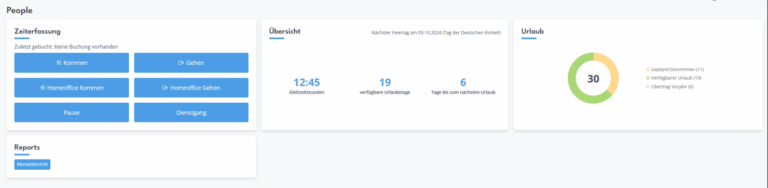
Digital time recording systems ensure complete and traceable documentation of working hours.
They reduce manual errors, facilitate evaluations and create a reliable database for HR, managers and the board.
➡️ Use automated checks
Modern systems can automatically check whether rest periods, break regulations or maximum working hours are being adhered to. Anomalies become visible at an early stage before they become a legal problem.
➡️ Define clear processes
In addition to the technology, clear rules are crucial. Companies should define how times are recorded, who is responsible for monitoring and how corrections or deviations are dealt with.
➡️ Involve managers
Managers play a key role in ensuring compliance with working time regulations. They must keep an eye on working hours, recognize anomalies and sensitize employees to correct time tracking.
➡️ Carry out regular checks
Internal spot checks, evaluations and regular process audits help to identify weaknesses at an early stage. This allows errors to be rectified before they become relevant in external audits.
Digital time tracking as a compliance factor
The demands on companies will continue to increase. Flexible working models, working from home, shift work and different working time models add to the complexity. A digital solution creates transparency here and supports companies in reliably implementing legal requirements.
At the same time, digital time tracking offers much more than just documentation:
- It improves processes,
- Reduces administrative effort
- and provides important data for personnel planning, payroll accounting and corporate management.
Conclusion: Avoid time tracking fines = take processes seriously
Missing or incorrect time tracking can have considerable consequences for companies – financially, legally and organizationally.
It is therefore crucial not just to introduce any system, but to establish time tracking as a
binding, comprehensible process in everyday life.
Companies that take this step consistently benefit twice over: they avoid fines and at the same time gain efficiency, transparency and legal certainty.
FAQ: Fines and time tracking in the company
Is time tracking mandatory in Germany?
Yes. According to the ECJ and BAG rulings, employers are obliged to systematically record their employees’ working hours. Companies must provide a system with which the start, end and duration of daily working hours can be documented.
How high is the fine for missing time tracking?
Fines of up to 30,000 euros can be imposed for violations of the Working Hours Act (ArbZG). The actual amount depends on the individual case.
Are there also fines for incorrect time tracking?
Yes. Incorrect or incomplete time tracking can also be sanctioned, especially if working hours, breaks or rest periods are not correctly documented.
Who is responsible for time tracking?
The responsibility lies with the employer. Even if employees record their times themselves, the company must ensure that the recording is complete, correct and comprehensible.
Is Excel sufficient for time tracking?
Excel is not automatically excluded in principle, but in practice it is prone to errors and difficult to check. Digital time recording systems offer significantly better options for checking, documentation and traceability.
How can companies avoid fines?
Companies should introduce a reliable and standardized time recording system, define clear processes, involve managers and regularly check compliance with working time regulations.