In production and manufacturing, time is a key control factor. Companies need to know,
🤔 When employees are on the job,
🤔 How shifts are staffed,
🤔 Where overtime occurs
🤔 and which time periods correspond to specific assignments or activities.
At the same time, machine data, production feedback, and operational data play an important role in planning, cost estimation, and controlling.
This is exactly where confusion often arises: Where does traditional time tracking end? When do we start talking about job-based time tracking? And what role does production data acquisition—or BDE, for short—play?
For manufacturing companies, this distinction is crucial. After all, not every system should do everything. Modern organizations clearly separate personnel data, order data, and operational data from one another and link this information via appropriate interfaces.
👉 This creates transparent processes without overloading systems with technical details.
⚠️ Why Time Tracking in Production Has Unique Requirements
Time tracking in manufacturing facilities is significantly more complex than in traditional office environments. Employees often work early, late, or night shifts.
❗️Shift changes must be properly documented,
❗️Breaks are taken into account correctly
❗️and surcharges are calculated in a transparent manner.
In addition, there are different work areas: production lines, assembly, warehousing, quality assurance, maintenance, work planning, and administration often follow different time-tracking models. While some employees clock in at fixed terminals, other departments require flexible or mobile time-tracking options.
👉 This creates a significant need for transparency for HR, production management, and executive management. Companies must not only document working hours but also be able to analyze them. This is the only way to identify overtime, capacity utilization, absences, and deviations from the schedule at an early stage.
⏰ Accurately tracking work hours in shift-based operations
Shift work is one of the most important use cases for digital time tracking in production and manufacturing. The more shifts, locations, and employees are involved, the more prone to errors manual processes become. Paper lists or Excel spreadsheets quickly reach their limits in this context.
✅ Digital time tracking makes it possible to document arrival and departure times in a structured manner. Breaks, shift changes, overtime, and absences can be systematically recorded. This provides a reliable basis for payroll processing, time accounts, and HR management.
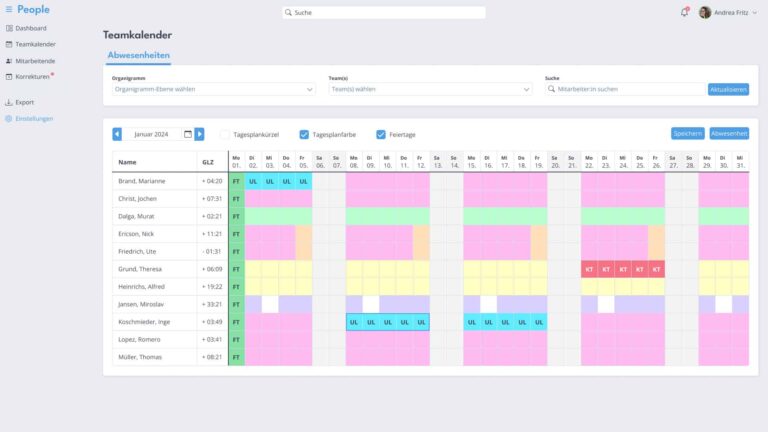
Time tracking becomes particularly valuable when it is linked to staff scheduling. This allows planned shifts to be compared with actual hours worked. Production managers can more quickly identify whether shifts are regularly understaffed, whether additional work is being performed, or whether certain areas are consistently overloaded. Learn more.
💡 Time tracking as the basis for fair and transparent work-time accounts
In manufacturing facilities, work-time accounts are often an important tool for balancing out fluctuations in order volume. During periods of high workload, employees accumulate overtime hours; during slower periods, they use up their accumulated time credits. For this model to work, working hours must be recorded accurately, completely, and in a traceable manner.
Digital systems provide transparency for all parties involved:
✅ Employees can track their time records,
✅ Managers keep track of overtime
✅ And HR gains a reliable data foundation for analysis and payroll processing.
🚨 This transparency is especially important in production, because time accounts can quickly lead to conflicts if time balances aren’t up to date or can’t be tracked. Digital time tracking reduces these risks and supports fair, transparent processes. Learn more.
📄 Job-Based Time Tracking: When employee hours are posted to jobs
In addition to basic time tracking, many manufacturing companies need an additional level of detail: tracking time spent on orders, projects, cost centers, or activities. This order-based time tracking shows how much staff time was actually spent on a specific order or production area.
This makes it clear that,
✅ which tasks are particularly time-consuming,
✅ where variances from the budget arise
✅ and which activities require a lot of staff time.
👉 This information is extremely valuable for post-project analysis, management control, and resource planning.
🚨 It is important to distinguish between these two concepts: Job-based time tracking does not automatically mean production data collection. While job-based time tracking primarily relates individual employees’ work and activity times to specific jobs or projects, production data collection (BDE) involves more extensive operational and manufacturing data.
🤔 Production Data and Time Tracking: Why Production Data Belongs in the ERP or MES System
Production data acquisition, or PDA for short, refers to the collection of production-related data such as machine runtime, downtime, unit counts, scrap, setup times, and production feedback.
🔗 This information is generated directly during the manufacturing process and is closely linked to production planning, materials management, machine capacity, work orders, and production controlling.
This is what fundamentally distinguishes BDE from employee time tracking. While employee time tracking documents when employees work, which shifts they work, and which working hours are allocated to orders, projects, or cost centers, production data analysis (BDE) provides insights into production progress, machine performance, and process quality.
👉 For this reason, production data should not be tracked in the HR time-tracking system. From a business perspective, it belongs in an ERP, MES, or specialized production system, where work orders, material flows, bills of materials, machine capacities, and production metrics are also managed. There, operational data can be analyzed in the correct business context and used for production control, post-calculation, and management accounting.
Time and attendance tracking supplements this system environment with personnel-related time data. It provides transparency regarding attendance, shift times, breaks, overtime, and order-related working hours. Through interfaces, personnel time data and operational data can be effectively linked without mixing their respective functions.
👉 This creates a clear system logic: employee time data belongs in the time management system, while operational and machine data belong in the ERP, MES, or production system.
🤝 How Time Tracking and ERP Systems Work Together Effectively
The greatest benefits are realized when the time tracking system and the ERP system are not operated in isolation from one another. Interfaces allow relevant data to be exchanged in a structured manner. For example, orders, cost centers, or projects can be transferred from the ERP system to the time tracking system. Employees then record their hours against the corresponding orders or activities.
The recorded times can then be used for post-calculation, billing, or controlling. This reduces duplicate data entry and makes analyses significantly more reliable.
👉 For manufacturing companies, this means that time tracking remains focused on its core function while also providing relevant information to related systems. It is precisely this integration that is often the key to efficient processes.
💡 Staff Scheduling in Manufacturing: Optimizing Shift Staffing
In addition to data collection, planning also plays a key role. Manufacturing companies must ensure that
❗️Shifts are adequately staffed,
❗️Qualifications match
❗️and staffing shortages are identified early on.
Integrated staff scheduling helps ensure that employees are scheduled according to demand. In manufacturing and production in particular, it is important to coordinate qualifications, work schedules, absences, and shift requirements.
👉 When combined with time tracking, this creates a closed-loop control system: Companies plan staff assignments, track actual hours worked, and analyze variances. Based on this, shift schedules, staffing needs, and utilization can be continuously improved.
🚧 Common Challenges in Production and Manufacturing
Many manufacturing companies face similar problems.
⚡️ Although working hours are tracked, they are not analyzed sufficiently.
⚡️ Order times are entered inconsistently.
⚡️ Shift schedules are created in separate Excel files.
⚡️ ERP systems contain order data, but not up-to-date employee time information.
Such data silos result in decisions being based on incomplete data. Production management, HR, and Controlling operate with different levels of information. This makes precise management more difficult and increases the amount of manual work required.
✅ A modern time-tracking system can bridge this gap by systematically recording employee hours and making that data available for use in other processes. However, it is crucial that the system’s boundaries remain clearly defined.
📈 Benefits of Digital Time Tracking in Production and Manufacturing
Digital time tracking offers manufacturing companies numerous advantages.
✅ It provides transparency regarding attendance, shift times, overtime, and absences.
✅ At the same time, it reduces the amount of manual data entry and correction work.
✅ Managers can more quickly determine whether shifts are staffed as planned or whether there are regular deviations.
✅ HR benefits from clearly documented working hours and time accounts.
✅ The Controlling department receives reliable information about personnel-related expenses.
���6 It is particularly important to link data collection and analysis. Only when data is systematically analyzed does time tracking provide real management value.
🔍 What Companies Should Consider When Choosing a Solution
1️⃣ When selecting a time-tracking solution, manufacturing companies should ensure that it supports various types of time tracking . In practice, terminals are often needed in production areas that function flawlessly even under harsh conditions (e.g., with appropriate IP protection ratings), supplemented by web access for administrative staff and mobile apps for decentralized teams.
2️⃣ Equally important is the ability to handle complex work schedule models. Shift work, premium pay, break policies, work-time accounts, and absences must be processed reliably.
3️⃣ In addition, companies should assess how well the solution can be integrated into existing ERP, payroll, or planning systems. A good time tracking solution does not create a new data silo but rather integrates seamlessly into the existing system landscape.
🤓 Conclusion: Digital time tracking creates transparency in production and manufacturing
Production and manufacturing require reliable time data to efficiently manage shifts, personnel resources, and workloads. Digital time tracking provides the necessary foundation for this :
✅ Working hours are documented in a transparent manner,
✅ Layer models are displayed more clearly
✅ and makes it easier to analyze job-related time.
This transparency is a decisive advantage, especially in production facilities with rotating shifts, multiple work areas, and high demands on planning and accounting. HR, production management, and controlling work on the basis of consistent data and can more quickly identify where overtime is occurring, where capacity is lacking, or where processes should be optimized.
💪 Digital time tracking is particularly effective when it integrates with staff scheduling, on-site tracking hardware, access control (learn more), and existing ERP or payroll systems. This creates an integrated system landscape in which each system fulfills its specific function and relevant data can be shared without the need for duplicate data entry.
Operational data from manufacturing remains a separate data domain. From a functional perspective, it belongs in ERP, MES, or production systems, while time tracking handles the HR-related aspects. This clear separation ensures streamlined processes and prevents systems from being unnecessarily overburdened.
👉 For companies, this means that digital time tracking is not just an isolated HR tool, but a key component of modern, efficient, and transparent production processes.
💡FAQ: Time Tracking in Production
What does time tracking mean in production?
Time tracking in production involves digitally documenting working hours, shift times, breaks, overtime, and absences. Depending on your needs, time can also be allocated to orders, projects, or cost centers. This provides a reliable foundation for payroll, work time accounts, HR management, and operational control. Learn more.
What is the difference between time tracking and production data collection?
Time tracking records personnel-related times such as start and end times, breaks, shifts, or job-related working hours. BDE, or production data acquisition, on the other hand, refers to production-related data such as machine runtime, downtime, unit counts, scrap, or production feedback.
Why shouldn't BDE data be included in employee time tracking?
BDE data is generated directly during the production process and is closely linked to production orders, machines, material flows, and production metrics. For this reason, it belongs in an ERP, MES, or production system. Employee time tracking supplements this system environment with working hours, shift times, and order-related employee time data.
Can time tracking still be integrated with ERP or MES systems?
Yes. Orders, projects, cost centers, or activities can be imported from ERP or production systems via interfaces. Employees then record their time against these structures. The recorded employee time can then be further processed for post-calculation, controlling, or payroll.
Why is digital time tracking important for companies that operate on shifts?
Shift-based operations require reliable data on attendance, breaks, overtime, premium pay, and absences. Digital time tracking reduces manual errors and provides transparency for HR, production management, and financial control. A centralized database is especially crucial when there are multiple shifts, locations, or work schedules.
How does time tracking support staff scheduling in production?
Time tracking provides the actual data that is essential for realistic staff scheduling. Companies can determine whether planned shifts were actually staffed as intended, where overtime occurs regularly, or which areas are frequently understaffed. This allows for more targeted optimization of shift models, staffing needs, and staff scheduling.
Why should time tracking and staff scheduling be linked?
When time tracking and staff scheduling are integrated, planned and actual working hours can be compared directly. This simplifies shift management, reduces planning errors, and provides transparency regarding variances. In addition, planned absences—such as vacation or short-term needs resulting from illness, for example—are factored into workforce planning. For manufacturing companies, this results in a seamless process from planning through time tracking to analysis.
What role do qualifications play in staff scheduling?
In manufacturing, it is not enough to staff shifts based solely on availability and quantity. Often, specific qualifications, authorizations, or levels of experience must be taken into account. Digital staff scheduling can help match employees to specific workstations, production lines, or tasks and identify bottlenecks early on.
Why is stationary data capture hardware useful in production?
In production areas, stationary time-tracking hardware is often particularly practical. Terminals located at entrances, in factory buildings, or along central walkways enable quick and consistent tracking of arrivals, departures, and breaks. Stationary terminals are a robust and practical solution, especially in situations where employees do not regularly work at a computer or where language barriers exist.
What type of data capture hardware is suitable for manufacturing facilities?
Typical examples include time-recording terminals that can be used with transponders, ID cards, RFID media, or other identification methods. It is crucial that the hardware is suited to the work environment. In production, durability, ease of use, fast clock-in processes, and a reliable connection to the time-tracking system play an important role.
When is mobile time tracking a useful complement to stationary terminals?
Mobile time tracking is useful when employees do not work at a fixed location on a permanent basis. This applies, for example, to maintenance, service, field work, rotating work sites, or decentralized production areas. In many companies, a combination of stationary terminals and mobile tracking is ideal because different work areas require different tracking methods.
Can time tracking be combined with access control?
Yes, time tracking and access control can be effectively combined. While time tracking records when employees are working, access control determines who is granted access to buildings, facilities, or sensitive areas. When these two areas are considered together, the result is greater transparency, enhanced security, and more efficient processes.
What are the benefits of access control in production and manufacturing?
In manufacturing facilities, there are often areas that should be accessible only to certain individuals, such as warehouses, machine rooms, R&D areas, server rooms, or hazardous-material zones. A digital access control system ensures that only authorized individuals are granted access. At the same time , access permissions can be managed centrally and quickly updated as needed.
Which systems should be networked with one another in manufacturing facilities?
An ideal system architecture is one in which time tracking, staff scheduling, access control, payroll, and ERP or production planning systems (PPS) work together seamlessly. Each system should fulfill its core functional role: employee time data in time management, shift and workforce scheduling in staff scheduling, access rights in access control, and operational data in the ERP or MES system.