Manual processes, such as manual time tracking, continue to shape day-to-day work in many companies, and tracking work hours is no exception. But what seems relatively simple at first glance often turns out, upon closer inspection, to be a real cost drain. Errors, wasted time, and unnecessary, repetitive tasks add up to staggering amounts that strain the budget year after year. In this article, you’ll learn why manual time tracking can become a problem for your company and how digital solutions—such as those from ZMI—can help you save time and money.
Manual Time Tracking: An Expensive Misconception
Many companies—including numerous HR managers and CEOs—are completely unaware of the hidden costs of manual time tracking. At first glance, this practice seems cost-effective and flexible—after all, it requires no additional technology or training, just a pen or a simple Excel spreadsheet. But it is precisely this apparent simplicity that is deceptive.
Costs at a Glance: A Sample Calculation
Manual time tracking involves numerous small tasks that may seem insignificant at first glance but can add up to massive costs over the course of a day or a month. Here is a specific example calculation:
Basis for calculation:
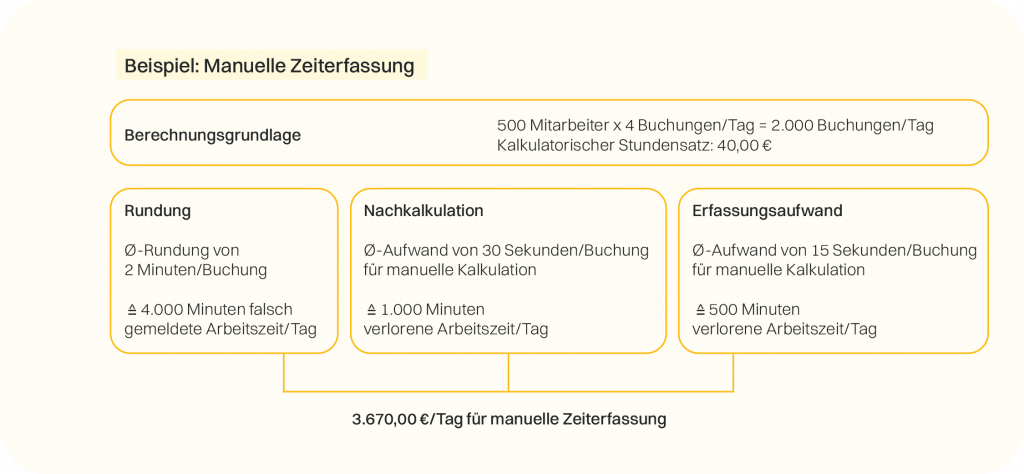
In our sample calculation, we assume a company with 500 employees who make four clock-in/out entries per day. These could include, for example, arrival, start of break, end of break, and departure. That amounts to 2,000 daily clock-ins and clock-outs. We’re using an average hourly rate of 40 euros for our calculations.
Rounding errors:
Even the smallest inaccuracies add up. If each transaction is rounded incorrectly by 2 minutes, that results in 4,000 minutes of error per day—a significant loss of work time and money.
Time for post-project analysis:
Manually processing times is time-consuming. With an average processing time of 30 seconds per entry, 1,000 minutes are lost each day just on this task alone.
Data Collection Effort:
Making reservations takes up work time. With an average of 15 seconds per reservation, a company wastes an additional 500 minutes a day on administrative tasks.
➡️ This results in total costs of €3,670— per day!
If you extrapolate these costs over the course of a year, the result is an enormous financial burden that can be avoided by using a digital time tracking system.
Challenges of Manual Time-Tracking Processes
The immense financial burden is only part of the problem. For one thing, valuable work time is lost—time that employees could use more productively. In addition, accuracy often suffers, as errors are almost inevitable when data is entered manually. An overview of the main disadvantages:
- High error rate: Manual data entry leads to rounding discrepancies and posting errors, which can negatively impact the efficiency of payroll processing.
- Time Wasted: Instead of focusing on productive tasks, employees waste time on administrative work.
- Lack of transparency: Without digital tools, there is no real-time overview, which is crucial for many HR managers and executives. This can lead to problems with tracking and planning, especially in shift-based operations.
Digital Time Tracking: A cost-effective Alternative
The solution is obvious: digital time tracking. With a tool like ZMI, employees and employers gain control over working hours and absences and can reduce hidden costs in the long term.
The benefits of digital time tracking:
- Error-Free Time Tracking: Automated time tracking minimizes errors such as incorrect entries and rounding discrepancies. The figures are always accurate and reliable.
- Faster, more efficient, and time-saving: Since data entry is automated, there is no manual work involved. This results in significant savings in time and resources.
- Transparency and Real-Time Reporting: With a digital solution, HR decision-makers have access at any time to accurate and clear working time data, which helps them keep track of key metrics and make informed business decisions.
- Compliant Documentation: This is how employers can stay on top of the requirements of the Working Hours Act and save time and effort during audits or inspections.
Time is money. What is your solution?
Manual time tracking is long outdated and incurs immense costs. It’s time to opt for a more modern and efficient solution. With a digital time tracking tool like ZMI, you can modernize your business, boost your employees’ productivity, and save money every day.